Human Trafficking Awareness 2026: The Critical Update You Need to Know
Explore the latest insights on human trafficking in 2026, from emerging trends and the national theme of stronger connections to actionable steps for prevention and survivor support.
human-traffickingawarenesspreventionsurvivor-support2026-update
Human Trafficking Awareness 2026: The Critical Update You Need to Know
Human trafficking is not a relic of the past—it is a fast-evolving crisis that demands our attention now more than ever. In 2026, the conversation has shifted from simple awareness to proactive, community-driven prevention and survivor empowerment, all under the unifying theme: Stronger Connections. Stronger Futures. This article unpacks the critical updates you need to understand the current landscape, recognize emerging threats, and take meaningful action whether you are a concerned citizen, a professional, or a community leader.
The Evolving Landscape of Human Trafficking in 2026
Human trafficking has grown increasingly complex, fueled by digital platforms, economic instability, and global displacement. While the core definition remains—force, fraud, or coercion to exploit someone for labor or commercial sex—the methods traffickers use have become more sophisticated. In 2026, we are seeing a surge in online grooming and recruitment, with traffickers leveraging social media, gaming platforms, and messaging apps to target vulnerable youth. The anonymity of the internet allows them to cast a wide net, making it imperative that parents, educators, and online safety advocates stay one step ahead.
Current Statistics and Trends
The latest data from the National Human Trafficking Hotline reveals that reports of trafficking have increased by 22% over the past two years, with a significant spike in cases involving minors and labor exploitation. The economic fallout of recent global disruptions has created fertile ground for traffickers, as job instability and housing insecurity push more individuals into precarious situations. In 2026, forced labor in agriculture, domestic work, and hospitality sectors remains underreported but widespread, while sex trafficking continues to exploit the most marginalized.
The Role of Technology as a Double-Edged Sword
Technology is both a weapon for traffickers and a tool for advocates. Artificial intelligence is now being used to detect trafficking patterns in online ads and financial transactions, but traffickers also use encrypted apps to evade detection. The rise of virtual reality experiences has introduced new avenues for exploitation, with reports of VR platforms being used to groom users. Meanwhile, survivor-led tech initiatives are developing apps that provide discreet help resources and safety planning tools. As we navigate this digital frontier, education on cyber safety is no longer optional—it is essential.
Who Is Most at Risk in 2026?
Vulnerability remains the common thread. Runaway and homeless youth, undocumented persons, LGBTQ+ individuals, and those with a history of trauma or substance use are disproportionately targeted. However, traffickers also exploit middle-class teens through "friending" schemes, where they pose as peers online to gain trust over weeks or months. In 2026, we are also seeing an increase in familial trafficking, where a parent or relative sells a child for financial gain, often under the guise of cultural norms. This highlights the need for nuanced prevention that addresses not only stranger danger but also family dynamics.
The 2026 National Theme: Stronger Connections, Stronger Futures
The Office on Trafficking in Persons has designated "Stronger Connections. Stronger Futures." as the theme for 2026, emphasizing that every relationship and community bond is a protective factor. This theme breaks the month into focus weeks, each targeting a specific sphere of influence: work, community, and family. The idea is simple: when we strengthen connections, we reduce the isolation that traffickers exploit. For organizations like the Rebecca Bender Initiative, this theme resonates deeply—our work has always centered on building networks of support that lead survivors from crisis to thriving futures.
Week 1: Introduction to Human Trafficking Prevention Month
The first week of January serves as a call to learn the basics. It’s an opportunity for businesses, schools, and faith communities to host training sessions that define human trafficking, dispel myths, and share the National Hotline (1-888-373-7888). In 2026, the focus is on trauma-informed education that doesn’t just scare people but empowers them with knowledge. For example, rather than simply listing red flags, training now includes trainings for community leaders and professionals and guidance on how to respond if someone discloses exploitation, emphasizing empathy and safety planning.
Week 2: Connection at Work
Workplaces are a critical front in the fight against trafficking—both because labor trafficking occurs within them and because employees can be vital eyes and ears. This year, the Department of Labor has updated its guidelines for identifying forced labor in supply chains, urging companies to scrutinize subcontractors and adopt fair hiring practices. For staff in hospitality, healthcare, and transportation, specialized training helps them recognize warning signs like an employee who isn’t allowed to speak for themselves or shows signs of physical abuse. Empowering workers to report concerns confidentially is a key objective.
Week 3: Connection in the Community
Communities thrive when neighbors, local businesses, and service providers collaborate. Week 3 encourages neighborhood watch programs to include trafficking awareness, libraries to host informational displays, and places of worship to integrate survivor support into outreach. The Rebecca Bender Initiative’s own "Find Your Specialty" community training has equipped thousands of professionals to identify and respond to suspected trafficking. In 2026, this grassroots approach is being scaled through human trafficking awareness and intervention programs and digital toolkits and peer-to-peer ambassador networks.
Week 4: Connection in the Family
The final week targets the family unit, recognizing that stable, supportive families are the first line of defense. Resources this year focus on digital parenting—helping caregivers have open conversations about online safety, set boundaries for screen time, and monitor apps for suspicious activity. Importantly, the theme also addresses the reality that some trafficking originates within families; thus, it highlights the need for mandated reporters and relatives to recognize when a child’s home environment is controlled by exploitation.
From Awareness to Action: Prevention Strategies for 2026
Awareness alone is not enough. The 2026 update demands a shift to actionable prevention that interrupts trafficking before it begins. This means tackling root causes like poverty, lack of education, and systemic inequality. The Rebecca Bender Initiative advocates for a public health approach to prevention, which includes early intervention programs in schools, economic empowerment for at-risk women, and community-based mentorship that builds resilience.
School-Based Prevention Programs
Schools are ground zero for grooming, but they can also be safe havens. In 2026, a growing number of states are mandating age-appropriate human trafficking education in health curricula. These programs teach students about healthy relationships, consent, and the tactics traffickers use to manipulate. For example, 3Strand’s Prev Edcurriculum now includes modules on recognizing abusive patterns and how to seek help from a trusted adult. As well as Street Grace’s Youth Leadership Academy focuses on confident kids being safe kids. Their impact is tangible: in districts that have adopted such curricula, hotline calls from youth have increased, indicating greater awareness and willingness to report.
Economic Empowerment as Prevention
Financial vulnerability is one of the strongest predictors of exploitation. Micro-enterprise initiatives, vocational training, and job placement programs that target survivors and at-risk populations are proven to reduce the likelihood of being re-trafficked. The 2026 update sees a rise in social enterprise partnerships that provide sustainable income opportunities while reinvesting profits into survivor services. These models not only prevent trafficking but also break the cycle of poverty that fuels it. We’re honored to partner with Annie Canons and Empowered Network on future job placement and job readiness collective impact models as well as Polaris Project’s Resiliency Fund which has shown a huge increase in long term impact by simply providing temporary financial support.
The Power of Public-Private Partnerships
No single entity can combat trafficking alone. In 2026, we are witnessing unprecedented collaboration between tech companies, law enforcement, and nonprofit organizations. For instance, data-sharing agreements now allow hotlines and task forces to analyze trends in real time, leading to faster identification of trafficking networks. The National Human Trafficking Hotline’s alliance with ride-share companies has trained drivers to spot and report potential victims, resulting in numerous rescues. These partnerships are a model for how cross-sector action can multiply impact.
Survivor-Centered Justice: A Paradigm Shift in 2026
Perhaps the most significant update in 2026 is the broad adoption of survivor-centered and trauma-informed practices. For decades, anti-trafficking efforts often prioritized arrests over victim well-being, but that is changing. Today, the focus is on meeting survivors where they are, offering choices rather than directives, and ensuring that services are accessible, culturally competent, and non-judgmental.
Legal Advocacy and Protection
Legal support is critical for survivors navigating the justice system. In 2026, more states have passed vacatur laws, allowing victims to clear criminal records for non-violent offenses committed while being trafficked. The Rebecca Bender Initiative’s legal team has been at the forefront of advocating for these protections, which remove barriers to employment, housing, and education. Additionally, 2026 sees expanded eligibility for federal victim assistance funds and equipping law enforcement to fight trafficking through improved access to U Visas and T Visas, though the backlog remains a challenge that advocates are pushing to address.
Comprehensive Aftercare and Restoration
True restoration extends beyond immediate crisis intervention. Survivors need safe housing, mental health care, substance use treatment, and educational opportunities. The 2026 model of care emphasizes long-term, holistic healing that can take years. Drop-in centers, peer mentorship programs, and survivor-led organizations are pivotal. The Rebecca Bender Initiative’s program provides life skills training, coaching, community and mentoring towards leadership so that survivors become the architects of their own futures.
Elevating Survivor Voices
A core principle of the 2026 movement is that nothing should be done for survivors without their input. Survivor consultants now sit on government task forces, contribute to training curricula, and lead awareness campaigns. Their expertise shapes policy and ensures that interventions are relevant and respectful. This shift has dismantled harmful stereotypes and highlighted the resilience of survivors, moving the narrative from pity to empowerment.
How You Can Make an Impact in 2026
Every person has a role to play in the fight against human trafficking. Whether you have five minutes or five hours a week, your actions can strengthen the net of protection around vulnerable individuals.
Learn and Share the Signs
Start by memorizing key red flags: a person who is not in control of their own identification documents, shows signs of physical abuse or malnourishment, is accompanied by someone who speaks for them, or seems fearful of authority. Share these signs on social media during Prevention Month and beyond. Use the hashtag #StrongerConnections2026 to amplify the message.
Support Ethical Businesses
Your purchasing power matters. Look for brands that disclose their supply chain practices and are certified as Fair Trade or Slavery-Free. Download apps that help you scan products for ethical ratings. When you choose to support companies that value fair labor, you reduce demand for trafficked goods.
Volunteer or Donate
Organizations like the Rebecca Bender Initiative depend on community support. You can mentor a survivor, help with administrative tasks, or contribute to our emergency fund that provides immediate assistance to those escaping exploitation. Even a small monthly donation sustains our 24/7 crisis line and long-term programs.
Advocate for Policy Change
Contact your representatives and urge them to support anti-trafficking legislation, fully fund victim services, and close loopholes that allow traffickers to exploit online platforms. The 2026 legislative session is considering bills that would require technology companies to report trafficking activity and increase penalties for those who profit from exploitation. Your voice can tip the balance.
Conclusion: The Future Is In Our Connections
Human trafficking is an affront to human dignity, but the 2026 update shows that progress is possible when we connect—across families, communities, and institutions. The theme “Stronger Connections. Stronger Futures.” isn’t just a slogan; it’s a roadmap. By staying informed, advocating for systemic change, and wrapping support around survivors, we can dismantle the networks of exploitation and replace them with networks of hope. The Rebecca Bender Initiative invites you to be part of this critical work. Visit our website, enroll in a training, or reach out to get involved. Together, we can ensure that everyone has the freedom and support to build a safe, thriving future.
Visual summary at a glance
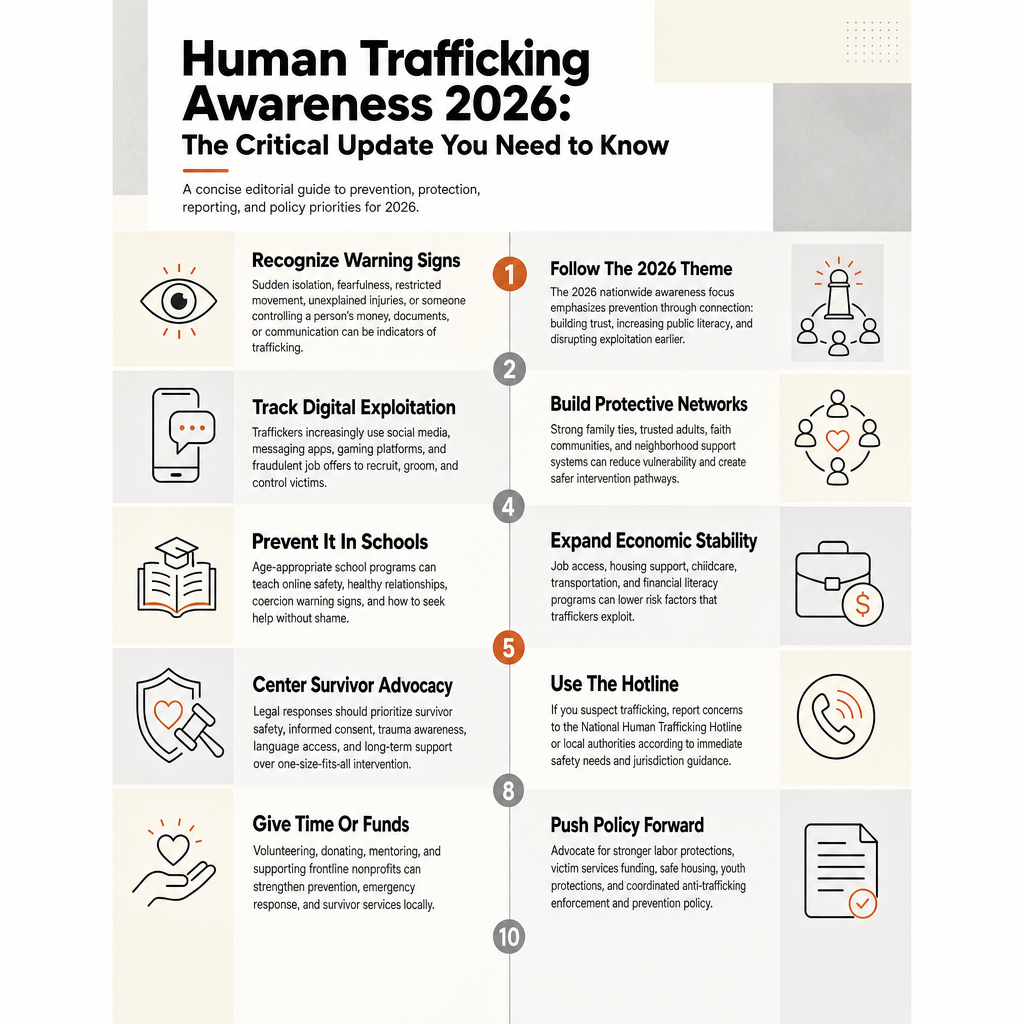
The infographic below distills the core journey of human trafficking awareness and response in 2026. It walks you through recognizing the issue, understanding the current context, taking preventive steps, and supporting survivors—all within the “Stronger Connections. Stronger Futures.” framework. Use it as a quick reference or share it to help others grasp the full scope of action needed.